Introduction
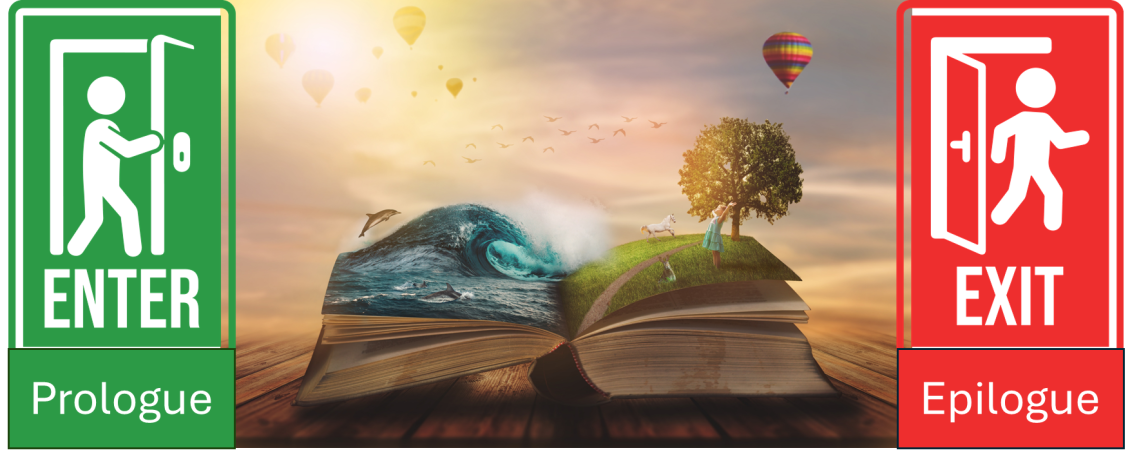
Amongst the writing community, there is a lot of discord and even occasional hatred regarding prologues and epilogues. I am not one of these, and I am basically very supportive of their usage in the right circumstances.
But what are they really, and what purpose do they perform? In this short blog, I am going to quickly explore my own understanding and usage of these story elements, taking both a practical author position and, with a light-touch, a psychological approach.
Moving between strange spaces
The psychologist Donald Winnicott first suggested the idea of a transitional space. He saw it as a not-quite-one-thing-or-another psychological area where our internal world of feelings and imagination pushed up against the external world in which we physically exist.
We develop this transitional space as young children, making sense of the outside world. It becomes an embedded and essential part of our psyche, necessary for us to have emotional growth and creativity. This psychological space allows us to interpret and shape our experiences through the filter of our imagination.
However, when we read a book, we engage it not only though our own transitional space, but in a very real sense, though the author’s as well. This is because the author’s own creativity was pushed out – transitioned – from an inner world into the pages of the story. In this way, when we become ‘immersed’ in a story we have often absorbed feelings that the author put there and hold them in our own internal world.
What I want to look at here now though is an extra layer of transition, where we enter into a fictional story from the real world, and then, story complete, exit back into the full reality of our lives. Of course we dip into and out of a book as we go about our daily lives – we have to deal with real world things after all – but once we enter that realm and commit to the journey, part of us will always remain until we leave via the proper exit that lies only at the end.
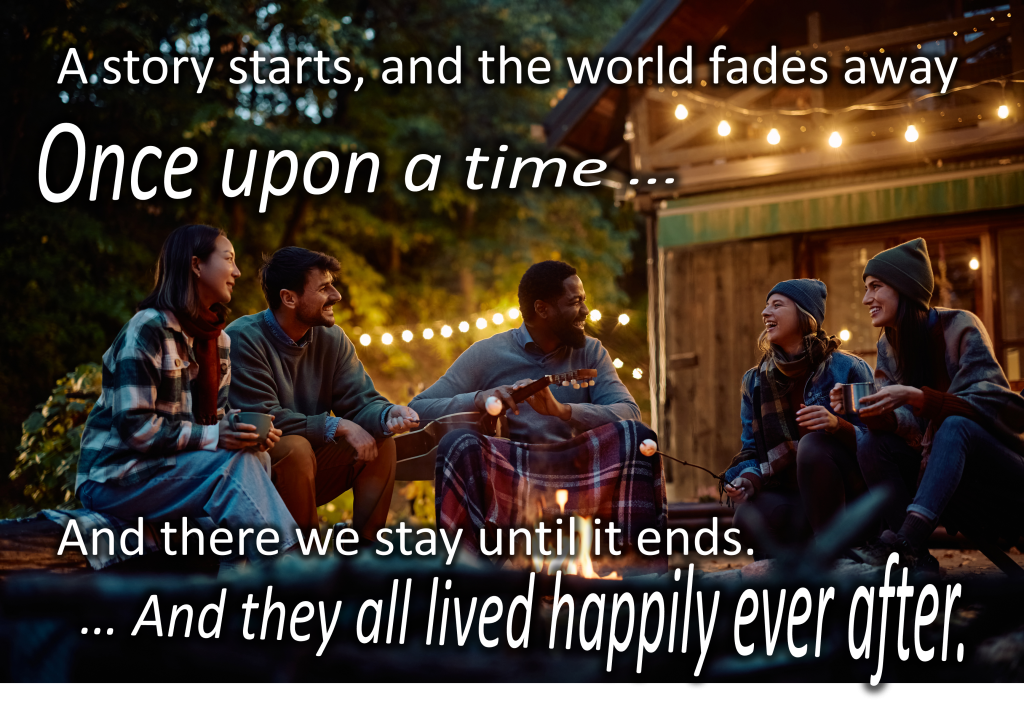
Of course, these transitions have always existed in writing. Picture yourself around a campfire with someone about to tell a story. The storyteller stand up and begins “Once upon a time…” and like that the world you are in slips away as you are transported into the world of the story, right up until the release key, the “… and they all lived happily ever after.” prompt opens the exit door and we step back into reality.
Transitional spaces can do many things from a psychological point of view. Chief among them is the ability to provide separation and permit us to differentiate between one (real) world and the other (fictional) world. We may be fleeing our real world horrors or we may be abandoning our safety nets to experience a world of fictional fear. Either way, the transition should be smooth and undamaging.
To travel between worlds like this there has to be rules. We have to ditch our luggage on entry, and travel light so that we may move freely and unencumbered. How can a story really move us when we are weighted down and fixed in reality? And when we leave we must feel a sense of completeness and know that we have passed back. We must be able to hold the experiences without being tied by them.
Of course we, as readers, generate these transitional spaces ourselves. But a good story gives us these spaces to use, and the often seen tool is that of prologues and epilogues.
Balancing and gift wrapping
For me, a story must always be balanced, as if the book held in your hand has equal weight at the beginning and the end. For this reason, I prefer to pair off my prologues and epilogues, never doing one without the other. Also, while these can be stylistically different from the main body of the story, they should never be different from each other.
Proper closure of the story should provide an exit to the real world that feels like the entrance taken at the start. In these transitional spaces, time can be slipped back or forward from the main story, but must be consistent to themselves. Point of view can be different to the main story, but again, have consistency between the pro/epilogues.
Of course, setting up the journey means issuing a return ticket at the start. The prologue has to set up a situation or a question for which the reader will expect, and rightly anticipate, an answer. It is the completion of this ‘promise’ that provides the transition out of the story.
Summary
Prologues and Epilogues can provide clear transitional zones to help the reader engage and appreciate the story. They are often best used as a paired tool to provide a clear ‘wrapping’ on the story, generating a sense of completeness at the end of the book.
But let’s be clear here, while these parts may be different in feel to the main body of the story, they are still very much a part of the story, placed there by a thoughtful author who has carefully constructed the complete tale for the benefit of their readers.
In doing this, authors invite readers into their own personally created space.
So don’t you go skipping the prologue and epilogue!